An AI visibility check is a fixed list of questions put to each AI assistant, with every answer recorded for whether it names your business, whether it links to your site, and who it names instead. A mention is your name appearing in the answer, and a citation is a link to your site among the sources the answer shows. The assistants that matter for most businesses are ChatGPT, Google's AI Overview (the AI-written summary that now sits above many Google results), Perplexity (an AI search engine that answers with links to its sources), Google's Gemini and Microsoft's Copilot.
What did we run on our own site?
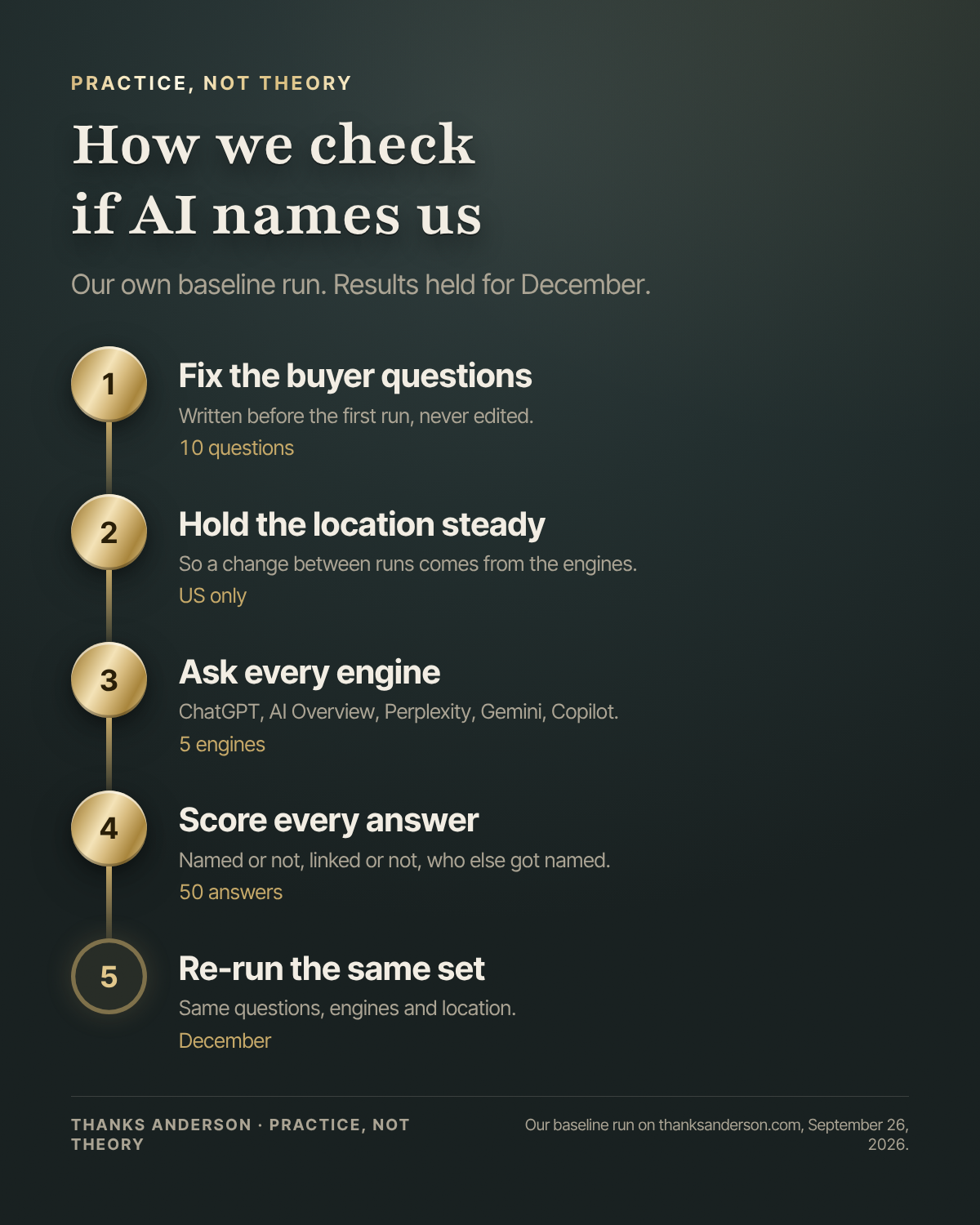
On September 26, 2026, I ran this check on thanksanderson.com using a paid tracking tool, meaning software that puts a fixed list of questions to the AI assistants on a schedule and records every answer. I gave it ten questions and five engines, ChatGPT, Google AI Overview, Perplexity, Gemini and Copilot, with the location set to the US only. Ten questions across five engines is fifty answers per run. A few of the questions name us, and the rest are the kind a buyer asks without knowing we exist.
I'm not publishing the results yet. That run is our "before", and the same ten questions go back through the same five engines in December. A before with no after only tells you where we started, so you'll get both at once. The questions stay private too, because a fixed set only measures anything if it stays fixed and nobody writes a page to suit it.
How do you run a rough version yourself?
You need a browser, a spreadsheet and an afternoon.
- Write five questions a customer would ask before they know your name. Full sentences, the way people talk to an assistant, with your town and their situation in them. For instance, "Who should I call to fix a leaking flat roof on a warehouse in Columbus?"
- Open a private browser window and stay signed out where the assistant allows it. Signed in, an assistant may draw on your earlier conversations, and an answer shaped by your own history is no guide to what a stranger sees.
- Ask every question in every engine twice, in a fresh chat each time. Five questions, five engines, two runs each is fifty answers. For Google's AI Overview, search the question on Google and note whether an overview appears at all, because Google only shows one "when our systems determine that generative AI can be especially helpful."
- Count. Of the answers to questions without your name in them, how many named you? That fraction is your rough visibility.
What should you write down for each answer?
One row per answer, with six columns: the engine, the question, which run, named or not, linked or not, and who else was named. The "who else" column shows you who the assistant thinks your competition is, which may not be the list you'd write.
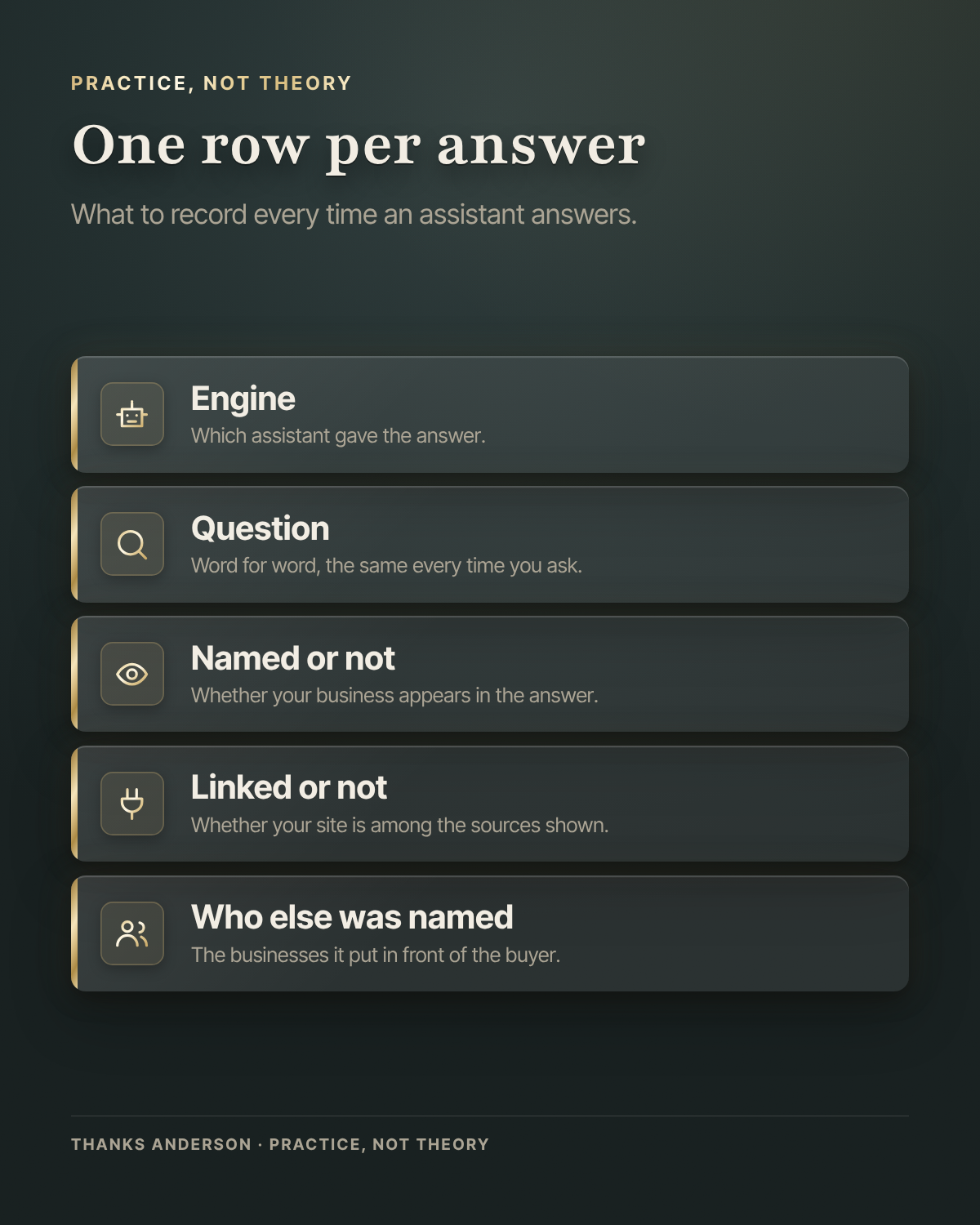
Get that sheet filled in and you know whether you're in the answer at all, who's there instead, which engine ignores you, which question comes closest, and which one to fix first... all of it from one afternoon.
What can't the free versions of these assistants show you?
Used by hand, each of these assistants answers one question for one person. Nothing in that chat window counts how often you're named across runs, keeps the previous answers to compare against, or shows you the result a customer in another city would get. What you have is one answer, for one person, in one place, on one day, and the spreadsheet is the only thing doing any counting.
That matters because the answers move. In January 2026, SparkToro published research in which about 600 volunteers ran 12 prompts, meaning questions put to an assistant, through ChatGPT, Claude and Google's AI a combined 2,961 times in November and December 2025, and found less than a 1 in 100 chance that ChatGPT or Google's AI would return the same list of brands twice. The authors suggest running a prompt 60 to 100 times before averaging, and measuring the share of answers that name you rather than any "rank". Two runs is a long way short of that.
When does the rough version stop being useful?
As soon as you want to know whether something you changed worked. Fifty answers from one afternoon are a snapshot, and the next fifty will differ even if you change nothing, so a small move up or down tells you very little.
It also stops being useful when you need to repeat it. A re-run only compares with the first one if the questions, engines, location and settings are identical, and by hand they drift: you reword a question, skip an engine, run it from your phone. And if your customers are in other cities, you're still only seeing what your own location gets.
That's the point where a tracking tool earns its fee, or where it's worth paying someone to run one for you, and it's where our AI visibility work starts. If you'd rather not run the two rounds by hand, the free AI visibility check asks five of the questions for you and shows the answer that matters most, with no email to see it. If you're still deciding whether AI visibility is your problem at all, the Bottleneck Finder™ is a free diagnostic that will tell you, with no email.
What won't a paid run tell you?
Ten questions are ten questions. Our run says whether five engines named us for those ten, from the US, on one day in September. It says nothing about what real buyers typed that week, because we have no view of what people actually ask, and nothing about why an engine picked one business over another.
It doesn't tell you whether being named turns into calls, either. That still needs a person asking new customers how they found you. And it covers nowhere outside the US, because we didn't ask it to.
We sell this work, so weigh that. That being said, if your customers don't ask an assistant before they call you, the rough version will show you that in an afternoon, and that's where you should stop and spend the money somewhere else.
Which question would you most want an assistant to answer with your name? Ask it this afternoon, and if you're already there, you can skip the rest.