A "bot", the way most people used the word, is any AI tool you talk to in a chat window, treated as one thing that either knows the answer or doesn't. A prompt is the instruction you type into one conversation. An AI skill is a saved, repeatable way of doing one job, written down once so the assistant does it the same way every time. Context is everything the assistant can see while it works on this conversation: what you typed, the files you gave it and any saved instructions it loaded. A project folder is the shared shelf that every conversation on one piece of work reads from.
When did people start saying "skill" and "context" instead of "bot"?
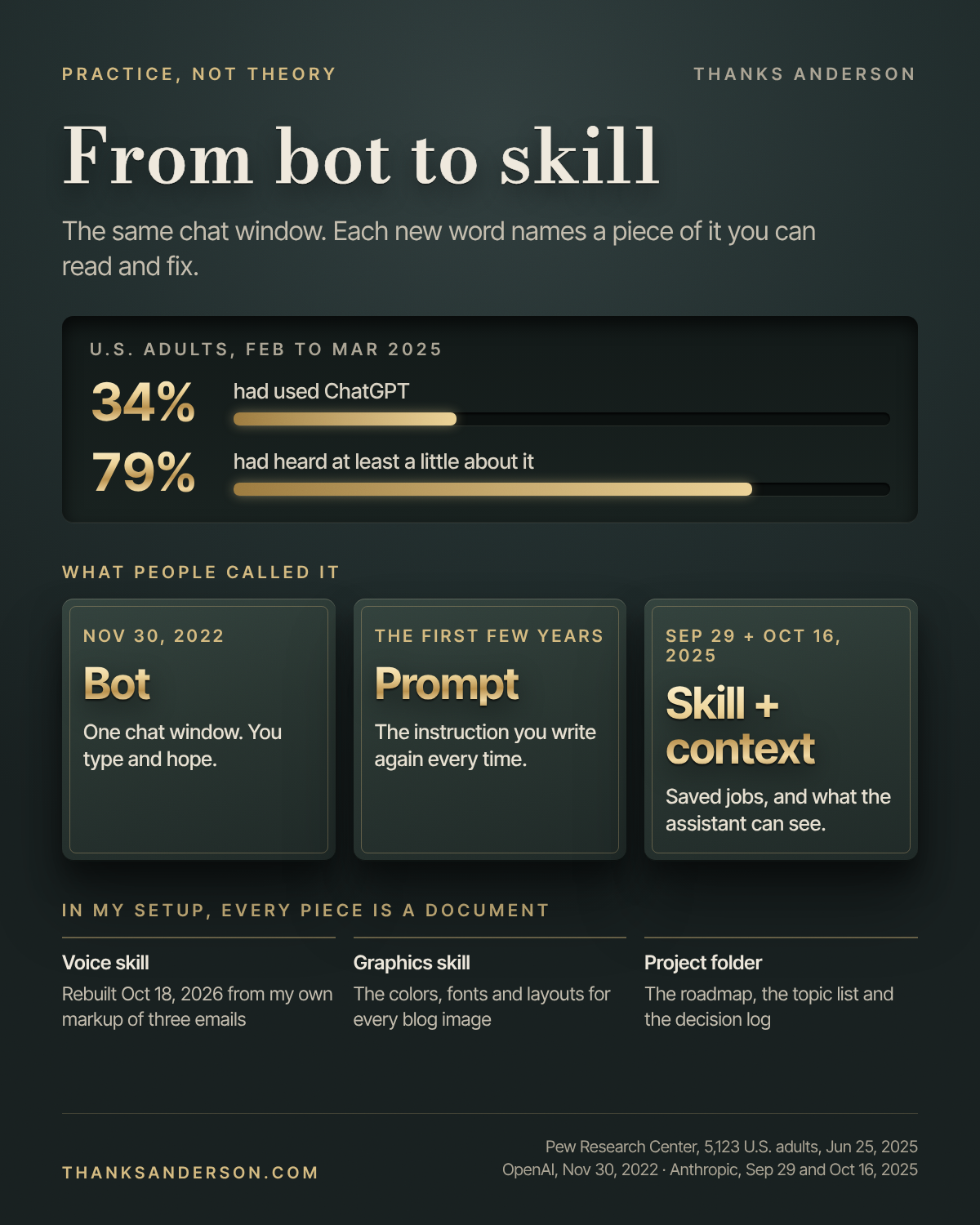
The products moved first, and the words followed them. When OpenAI introduced ChatGPT on November 30, 2022, it described a model "which interacts in a conversational way," and for most people that chat window became the "bot". By the time Pew Research Center surveyed 5,123 U.S. adults between February 24 and March 2, 2025, 34% said they had used ChatGPT and 79% had heard at least a little about it, up from 58% who had heard of it in March 2023.
Then the pieces got names. Anthropic, the company that makes Claude, added Projects on June 25, 2024, which bring "curated sets of knowledge and chat activity in one place," the shared shelf. On September 29, 2025 its engineers published a guide to context engineering, which they call "the natural progression of prompt engineering," the craft of writing good instructions that dominated the first few years. And on October 16, 2025 it introduced Agent Skills, "organized folders of instructions, scripts, and resources," and compared writing one to "putting together an onboarding guide for a new hire."
What does the change look like inside one small business?
My business runs on all three pieces, and every one of them is a document I can open and read. My voice skill is the saved set of instructions that keeps anything written under my name sounding like me, and I rebuilt it on October 18, 2026 from my own line-by-line markup of three outreach emails, so every rule in it is one of my own edits. My graphics skill holds the colors, fonts and layouts for every image on this blog. And the project folder is the shelf every conversation about this site reads from: the roadmap, the topic list and the decision log... so a new conversation starts out knowing what was decided last week.
None of that is a "bot". It's a set of written instructions and a shelf of documents, and the assistant does the legwork inside them while I decide what goes out. So, when something comes back wrong, I don't argue with a box, I open the skill or the folder and fix the line that caused it.
That's why I think the change in words matters for an owner who isn't technical. When a vendor tells you their AI tool uses skills and context, ask to read them, because a tool whose instructions you can read is a tool you can check, correct and keep if the vendor goes away. Done well, the setup saves you time, makes your people more efficient, keeps every customer email in the same voice, stops the same mistake from coming back and lets you move your work to a different tool when you need to... all of it.
Where does the new vocabulary not help?
The words can be borrowed by anyone. A vendor can rename the same closed chat box a skill, an agent or an assistant without changing what's under it, so ask to see the instructions and the documents it reads before you believe the label. If they can't show you, it's still a "bot".
A skill is only as good as what's written in it. My voice skill works because the rules came from my own edits on real emails, and a skill written from a generic template gives you generic output, just more consistently.
Context has limits too. Anthropic's own guide says context "must be treated as a finite resource with diminishing marginal returns," and describes "context rot," where the assistant recalls any one piece less reliably as more gets loaded in. So, stuffing every document you own into a project folder can make it worse, and someone still has to choose what goes on the shelf.
And if you use AI to draft an email twice a month, you don't need any of this. A plain, well-written prompt is fine, and our Better Prompt page shows how to write one in six lines. If you have jobs your team repeats every week the same way, that's where a skill earns its keep, and it's the kind of thing we build in our custom AI tools work.
Which job in your business would you write down first, if the assistant would follow it the same way every time?
If you're not sure, the Bottleneck Finder™ is our free diagnostic, tested across 42,000 combinations, and it will tell you which job to start with, or that the answer is to build nothing yet. No worries either way.