A product demo is a recorded or live walkthrough a seller uses to show what their tool does. A self-serve tool is software you set up and run yourself, with little or no help from the seller. An upsell is a second, more expensive offer sold after the first purchase, usually coaching, a private community or a done-for-you service. The trouble starts when the demo shows the upsell and the price buys the self-serve tool.
What does it look like when the tool doesn't match the demo?
I've paid for a few AI tools that worked great... in the sales video. Ha ha! Anyone else been there?
The first was an ebook builder, and the sales video showed it doing the research, finding the images and building out the whole ebook, all cut together so it looked like one smooth run. When I got in, the editor was at least half manual and nothing was as automated as the video... and the real product turned out to be a coaching membership where the seller teaches you how to build the thing the tool was supposed to build.
The second one promised to connect to my ad platforms, write the ad copy, make the images in every size and get it all wired up and ready to publish, on a membership that charged by usage. The ads looked terribly like AI made them and had errors all over the place, one part of it couldn't connect to my ad account at all, the ad scoring didn't line up with how the ads actually performed, and the list goes on. Again, the real offer was a smaller community with a much bigger price tag.
The third one hurt the most. I paid a $6,500 setup fee and $200 a month for an AI call agent that took inbound calls, made outbound calls, handled my website chat and booked meetings, and I provided most of the information to get it set up. About a month ago I found out that company filed for bankruptcy, and to top it off, I bought it about eight months before I had the skills and tools to build the same setup myself, and build it better.
Now I can build anything I want... custom and streamlined and have full control. Why? Because I saw the need for it and the opportunity to help a lot of people and businesses.
I would still pay for expert help... So, if what I'm looking at is a higher-priced service or a coaching program, that's what I want to know before I pay for it, and if I think I'm getting a self-serve tool that does three things, then I expect it to do those three things.
How often does a software purchase go wrong?
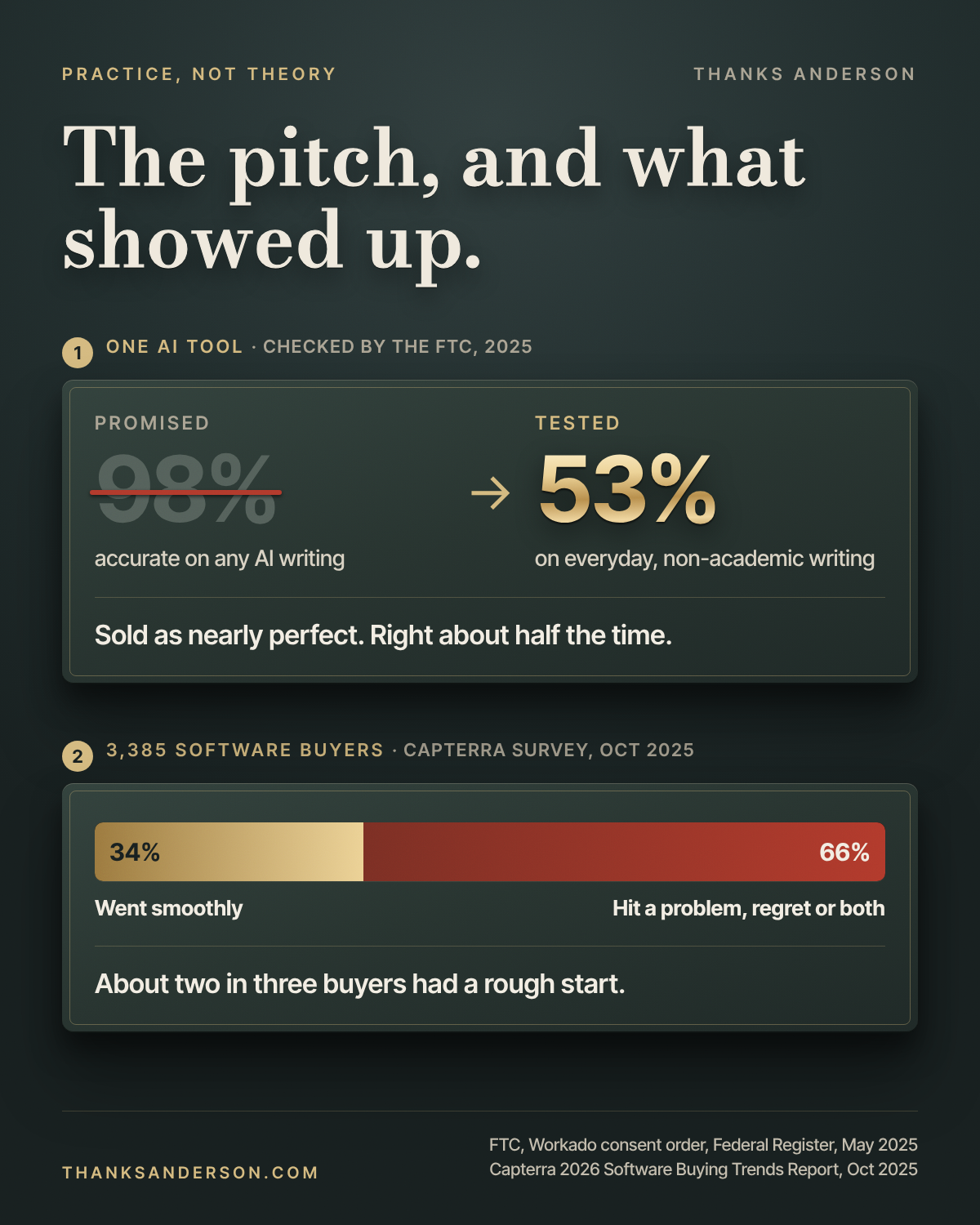
More often than most people plan for. Capterra's 2026 Software Buying Trends Report, released October 7, 2025 from a survey of 3,385 software decision makers in 11 countries, found that only 34% of buyers got through buying and setting up a tool without an unexpected disruption or regret. The other 66% hit one or both, and 89% of the buyers who regretted a purchase had run into an unexpected disruption while setting it up first.
And sometimes the promise itself doesn't hold up. For instance, in a case the Federal Trade Commission settled in 2025, the agency said the maker of an AI text detector sold it as more than 98 percent accurate on writing from any AI program, when the model behind it was trained to sort only academic writing well, and in testing it sorted non-academic AI writing correctly about 53 percent of the time. That's from the FTC's analysis of the proposed consent order, published in the Federal Register on May 2, 2025.
What should I ask before I pay for an AI tool?
These are the questions I'd ask now, and I'd ask to see the answers on your own material instead of in the video.
- What does the tool do without me, and what do I still do by hand? Ask them to run it on one of your real jobs, live, instead of showing you the recorded video again.
- Is everything in the demo in the plan I'm buying, or is some of it in a higher tier, a coaching group or a done-for-you service?
- Can I try it on my own material before I pay, or get my money back if it doesn't do what the sales page says?
- Does it connect to the accounts I already use, by name, and can you show me it connected to one?
- Who do I talk to when it breaks, and what happens to my setup and my data if your company goes away?
A seller with a good tool can answer those in a few minutes, and a seller who's really selling coaching will tell you it's coaching, which is fine if that's what you want. If the answers get vague, that tells you most of what you need to know.
When the tool fits, it can save you time, cut the busywork, make you more money and take a real load off your team... all of it.
It just has to be the tool you were shown.
When doesn't the gap between demo and tool matter?
When you knew what you were buying going in. Plenty of good tools need setup, your information and some trial and error before they earn their keep, and my call agent needed a lot of my information to work at all, which was fair. A tool sold honestly as an early version, or as software plus coaching, is a reasonable buy as long as the price and the description match.
The questions above won't catch everything either. A company can answer every one of them well and still go under like mine did, and nothing you ask protects your setup if the only copy of it lives on their side, so keep your own written copy of your prompts, scripts and settings wherever you can.
We build custom AI tools, and depending on the size of a business, an off-the-shelf product likely still needs adjustments to work for yours and isn't the most cost-effective option... For instance, the usage cost (what an AI company charges for the text its model reads and writes, counted in small pieces called tokens) can be controlled much more efficiently when someone like me sets up only what your business needs. Out-of-the-box software also tends to come with a lot of extra features and tools you don't need and would never use.
That being said, if an off-the-shelf tool does the job you need at a price that works, buy it. If you're not sure what to automate in the first place, the Bottleneck Finder™ is our free diagnostic, and it will tell you when the answer is to build nothing. And if you want an AI system tested on your own real cases before anyone relies on it, that's our AI governance and evaluation work.
Have you bought a tool that didn't match its demo?
If you're looking at one right now, send me the sales page or the demo link through the contact page, and I'll tell you the questions I'd ask that seller before you pay, free of charge.
And if it turns out to be a great tool, I'll tell you that too.