A definition-lead opening is a first paragraph that states what the thing is in "X is ..." form and answers the page's main question before any background. The first 200 words of a page are roughly its first two or three paragraphs, the stretch a visitor reads before deciding whether to scroll, and the stretch an AI assistant like ChatGPT leans on most when it decides what to quote.
I wrote the old openings on our own site, and they sounded great... to me. Ha ha! Anyone else ever read their own homepage and realized it never says what they do?
What did our own pages say before we fixed them?
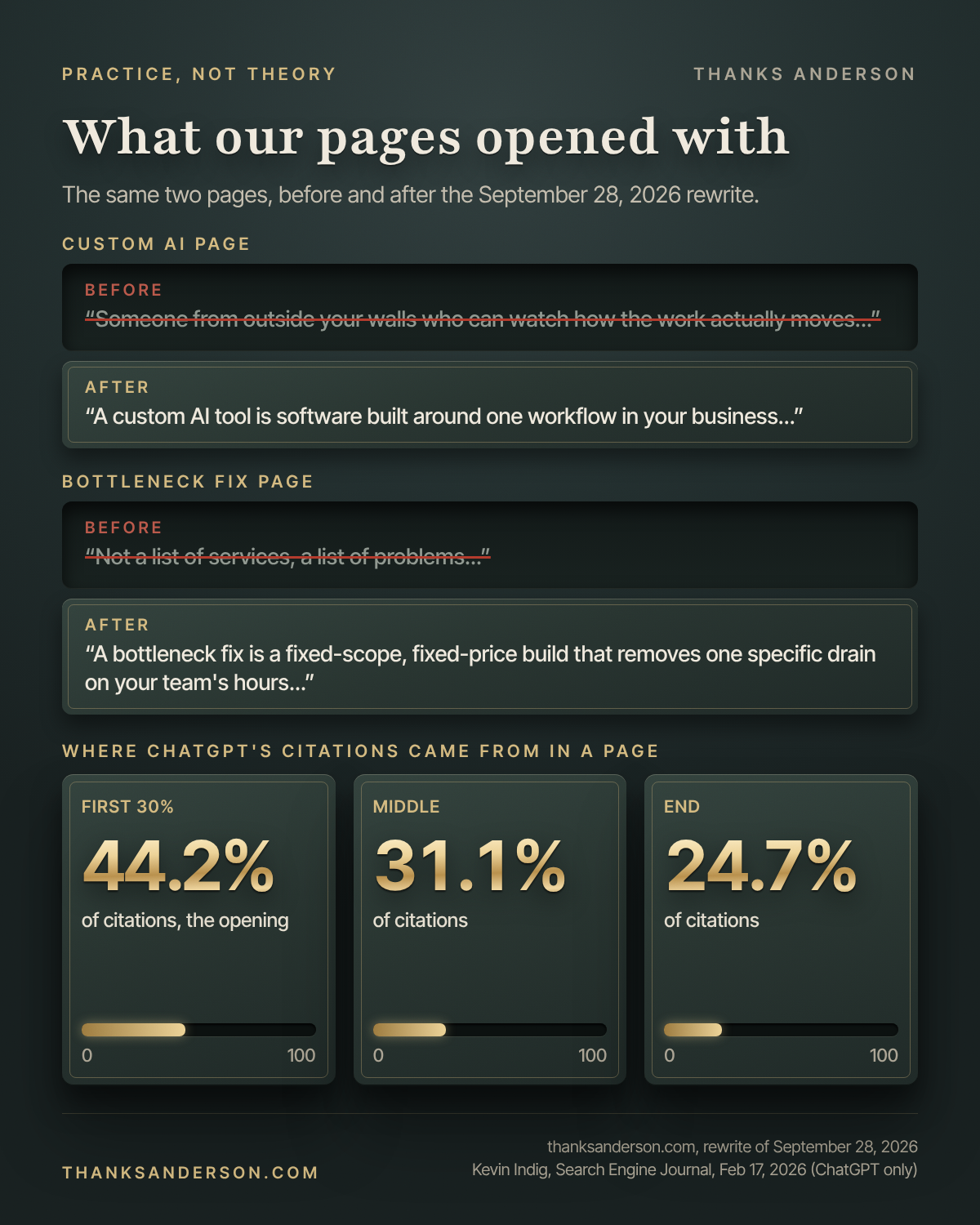
Mood lines. On September 28, 2026 we rewrote the openings of our main pages on thanksanderson.com, and the change is dated in our site's history, so here's the before and after on our own custom AI page, word for word.
Before, the first line under the headline was: "Someone from outside your walls who can watch how the work actually moves, find where the hours disappear, and build the thing that fixes it." It's a decent line, and it never says what we sell. A reader who stopped there knew we were helpful. They didn't know we build software.
After, it reads: "A custom AI tool is software built around one workflow in your business, grounded in your own documents and rules, that does the legwork and hands the decision back to a person." The mood line didn't go away. It moved to the second sentence, after the definition, and picked up the one number that proves it: "a working system, validated on 1,000+ real cases."
Our bottleneck fix page had the same problem in a different shape. It opened by telling you what it wasn't, "Not a list of services," before it ever said what a fix is. Now the first sentence is the definition, and the price promise comes with it.
Why does the opening carry so much weight?
Because that's where both of your readers stop. Pew Research Center tracked the browsing of 900 U.S. adults in March 2025 and reported on July 22, 2025 that people who got an AI summary at the top of a Google search clicked a regular result in 8% of visits, against 15% for people who didn't. A link inside the summary got clicked in just 1% of those visits. So, more and more of your page's first impression happens inside someone else's summary of it.
The assistants writing those summaries read top-heavy, too. Kevin Indig's analysis of ChatGPT citations, published in Search Engine Journal on February 17, 2026, traced 18,012 citations back to where they sat on the page and found 44.2% came from the first 30% of the text, 31.1% from the middle and 24.7% from the end. The same analysis found the most-cited passages were almost twice as likely to use plain defining language, words like "is" and "refers to," 36.2% against 20.2%.
Get the opening right and a visitor knows in ten seconds whether they're in the right place, the assistant has a sentence it can lift without rewriting, your sales calls start with people who already know what you do, and you stop explaining yourself on every first call... all of it.
What goes in the first 200 words, in order?
Four things, and you can check your own page against them tonight:
- What it is, in one "X is ..." sentence a stranger could repeat. Say "a custom AI tool is software built around one workflow," and skip "we partner with growing businesses."
- Who it's for, by size, trade or situation, so the wrong reader leaves early and the right one stays.
- The answer to the question in your page title, stated plainly, even if it's "it depends" followed by what it depends on.
- One proof, a number you can source or a fact you can show. Ours on the custom AI page is the 1,000+ real cases.
Then the story, the welcome, the mission line and the photos. They still matter, they just go second. Our AI visibility work starts with exactly this rewrite on a client's most important pages, and our SEO, AEO and GEO explainer shows the rest of the method.
Where doesn't a better opening help?
It won't save a page nobody finds. If the page doesn't rank and nothing links to it, the best opening in the world gets read by nobody, and that's a different fix.
It's not a secret format, either. Google's own Search Central guidance on AI features, last updated December 10, 2025, says there are "no additional requirements to appear in AI Overviews or AI Mode, nor other special optimizations necessary." A clear opening works because it's good writing for people, and the AI reads the same page.
The research is narrower than the headlines. The Indig analysis covers ChatGPT only and shows where citations came from, which isn't proof that rewriting an opening earns more of them. And "lead with the definition" is our own house rule. We once credited it to a Princeton study and had to correct that site-wide, because the study tested other methods. We haven't measured what our September 28 rewrite did on its own yet, and we'll say so plainly when we re-run our own check in December.
And if you can't say in one sentence what you sell and to whom, no opening will fix that. Settle the sentence first, then write the page.
If someone read only the first paragraph of your most important page, could they tell a friend what you sell?
Send me that page through the contact page and I'll tell you whether its first 200 words answer the question that brings people to it, and what I'd move up. No worries either way.